

One of the most common problems in oral and jaw health, an impacted tooth refers to a tooth that remains fully or partially unerupted beneath the jawbone or gum tissue. This condition, seen particularly with wisdom teeth, may sometimes cause no symptoms at all, while at other times it can lead to pain, a feeling of pressure, and infection in the surrounding tissue.
This article has been prepared in light of current literature, clinical observations and experience in oral and maxillofacial surgery practice. The aim is to provide accurate, accessible information about impacted teeth while assessing the subject from a holistic perspective.
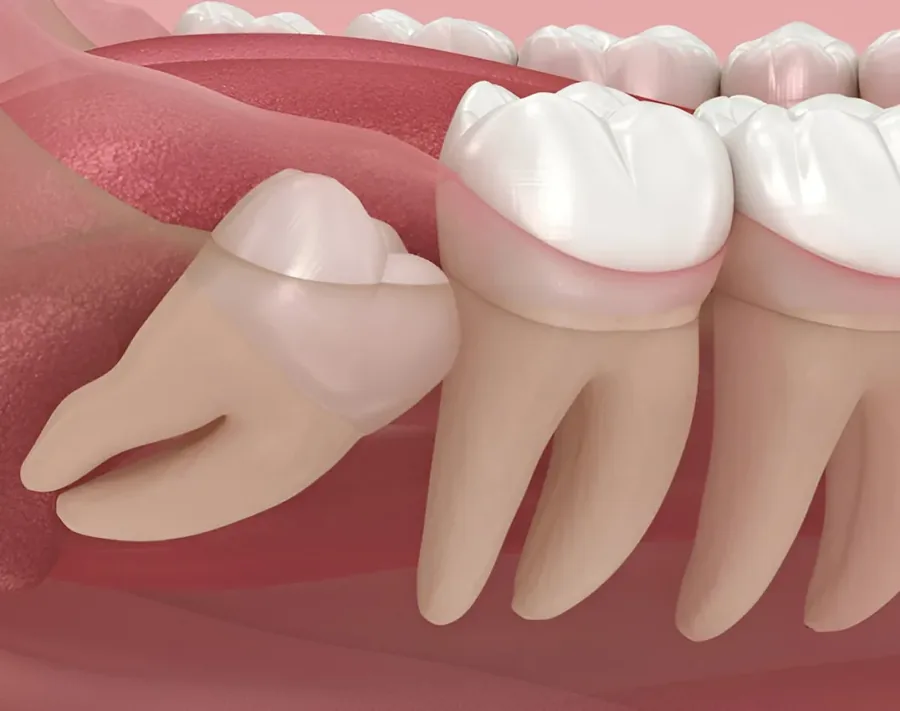
What Is an Impacted Tooth and Why Does It Occur?
An impacted tooth is one that, despite being due to erupt, fails to take its place in the dental arch and remains within the jawbone or beneath the gum. Tooth development begins during the embryonic period and is completed according to a defined chronology. However, during this process, eruption can be disrupted by insufficient space, genetic factors, or positional abnormalities.
The teeth most commonly affected are the third molars, better known as wisdom teeth. However, canines and second premolars can also become impacted. Insufficient space in the jawbone, horizontal or angled positioning of the tooth, and pressure from neighbouring teeth are among the primary causes.
Research shows that as the jaw structure has become smaller over the course of evolution, the incidence of impacted teeth has increased. The effect of modern dietary habits on jaw development is also considered one of the contributing factors to this trend.
What Are the Symptoms of an Impacted Tooth?
Not every impacted tooth causes symptoms. Some cases progress completely silently and are only discovered incidentally during routine radiographic examinations. In symptomatic cases, however, a range of clinical findings can emerge.
The most commonly reported symptoms are:
- A feeling of pressure or fullness in the back of the mouth
- Pain while chewing
- Gum swelling and redness
- Difficulty opening the mouth
- Bad breath
A partially erupted impacted tooth can create conditions for bacteria to accumulate in the gum pocket. This can lead to an inflammatory condition known as pericoronitis. Clinical studies show that this risk is particularly higher for impacted wisdom teeth located in the lower jaw.
Types and Positions of Impacted Teeth
Cases of impacted teeth can be classified according to their position. This classification plays an important role in surgical planning. One of the most commonly used classification systems in oral surgery literature is the Winter classification.
The table below summarises the positions of impacted teeth:
|
Position Type |
Definition |
Clinical Significance |
|
Vertical |
In the normal eruption path but unable to emerge |
Relatively straightforward surgery |
|
Horizontal |
Parallel to the adjacent tooth |
Risk of pressure on the adjacent tooth |
|
Mesioangular |
Angled forward |
Common type |
|
Distoangular |
Angled backward |
Surgical difficulty may increase |
There is also a clinical distinction between fully bony-impacted teeth and partially impacted teeth. A fully impacted tooth is entirely encased within the bone, while a partially impacted tooth is partly exposed to the oral environment.
This classification helps predict potential complications. For example, a horizontally positioned impacted tooth can increase the risk of resorption on the root surface of the second molar.
How Is an Impacted Tooth Diagnosed?
An impacted tooth is diagnosed through clinical examination and radiological assessment. A panoramic X-ray is the first-choice imaging method in most cases. In more complex situations, cone-beam computed tomography, which provides three-dimensional imaging, may be used.
The following criteria are assessed during radiographic evaluation:
- The position of the tooth
- Its relationship with adjacent teeth
- Its distance from the nerve canal
- The presence of a cyst or lesion
The relationship between an impacted tooth in the lower jaw and the inferior alveolar nerve is particularly important for surgical risk assessment. For this reason, the diagnostic process covers not only the presence of the tooth but also its anatomical relationships.
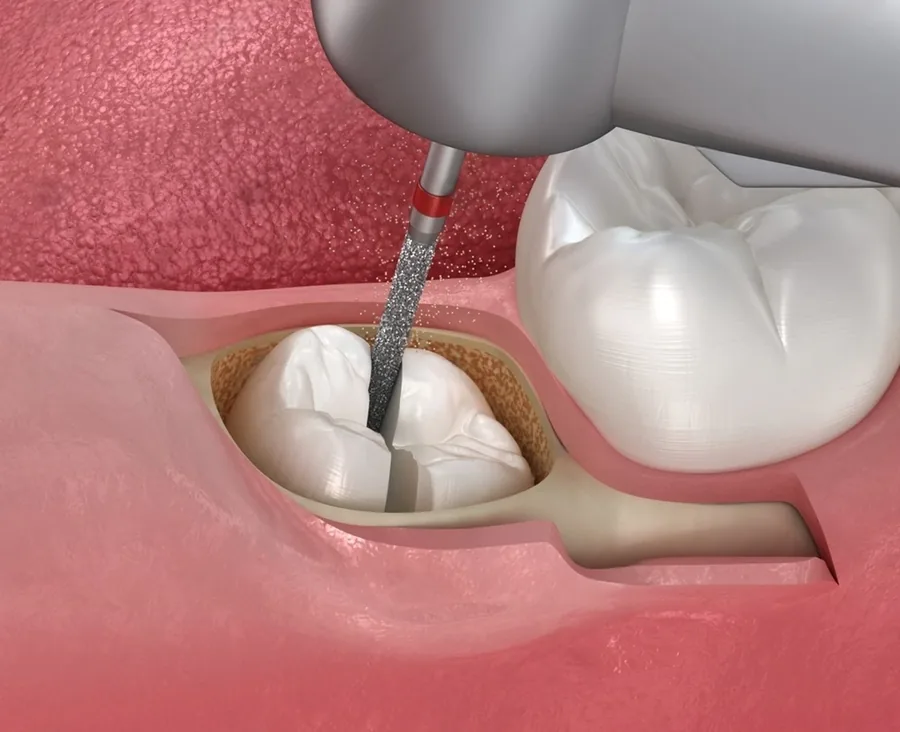
How Is Impacted Tooth Surgery Performed?
Impacted tooth surgery is a planned surgical procedure carried out by oral and maxillofacial surgery specialists. The procedure is usually performed under local anaesthesia, although sedation may be preferred in some cases.
The surgical process generally consists of the following stages:
- Administering local anaesthesia
- Carefully opening the gum tissue
- Removing bone tissue if necessary
- Extracting the tooth
- Cleaning the area and placing sutures
In cases of fully bony-impacted teeth, the tooth may be sectioned into pieces for removal. This technique aims to minimise trauma to the surrounding tissue.
The duration of the operation can vary depending on the position of the tooth. A horizontally positioned impacted tooth generally requires more extensive surgical planning. Nevertheless, most procedures are completed with same-day discharge.
The Recovery Process and Possible Outcomes After Impacted Tooth Surgery
The recovery process following the extraction of an impacted tooth varies depending on individual factors. Mild swelling and tenderness may be seen in the first few days. Clinical research shows that, with the right surgical technique and proper aftercare, complication rates are low.
Possible outcomes include:
- Temporary swelling
- Mild bleeding
- Limited mouth opening
- Rarely, nerve sensitivity
In cases of impacted teeth in the lower jaw where there is close contact with the nerve, a temporary feeling of numbness may be reported. This is usually transient and resolves within a certain period.
The healing process generally shows noticeable improvement within a week, while the complete reorganisation of the tissues is a longer biological process.
What Happens If an Impacted Tooth Is Not Removed?
Not every impacted tooth requires surgery. However, monitoring may be recommended if certain risk factors are present. Teeth that remain within the jawbone for a prolonged period can, in some cases, create the conditions for cyst formation.
Possible effects reported in the literature include:
- Decay in the adjacent tooth
- Root resorption
- Formation of periodontal pockets
- Rarely, cystic structures
For this reason, regular check-ups are important when an impacted tooth is present. The decision-making process requires individual assessment, and each case must be analysed on its own merits.
An impacted tooth is defined as a developmental dental anomaly that often progresses silently but can, in certain circumstances, lead to clinical problems. Radiological examination plays a major role in the diagnostic process, while surgical planning is shaped by the tooth's position, its anatomical relationships and individual factors.
At Doctor Afra, our aim is to support informed decision-making by providing scientific, accessible information about impacted teeth. Dental health matters not only for aesthetics but also for overall health. Regular check-ups and expert assessment therefore play a major role.
Book an appointment for your smile
Get in touch with us for your questions and treatment options.