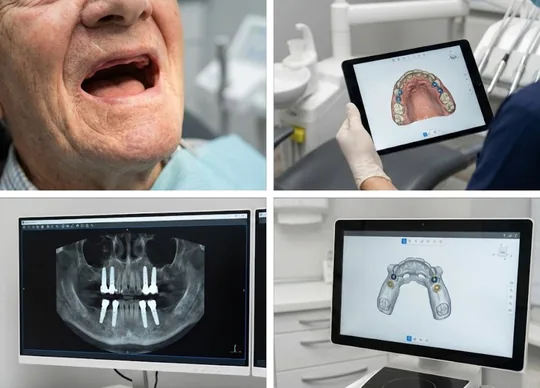
The All-on-4 Implant is a modern treatment protocol aimed at providing a fixed restoration on four implants placed in a single jaw, for patients who are completely edentulous or have suffered advanced tooth loss. Developed specifically for cases with limited bone volume, this technique offers the chance to obtain fixed teeth with less surgical intervention compared with conventional implant procedures.
Fixed Solution
Offers a fixed structure as an alternative to removable solutions.
Bone-Friendly Planning
The existing bone structure is used with maximum efficiency.
Rapid Return to Function
In suitable cases, functional use can be achieved quickly.
Personalised Approach
Treatment is planned according to individual anatomical and functional needs.
What Is the All-on-4 Implant? How Is the Four-Implant Technique Performed?
The All-on-4 Implant is a modern treatment protocol aimed at providing a fixed restoration on four implants placed in a single jaw, for patients who are completely edentulous or have suffered advanced tooth loss. Developed specifically for cases with limited bone volume, this technique offers the chance to obtain fixed teeth with less surgical intervention compared with conventional implant procedures.
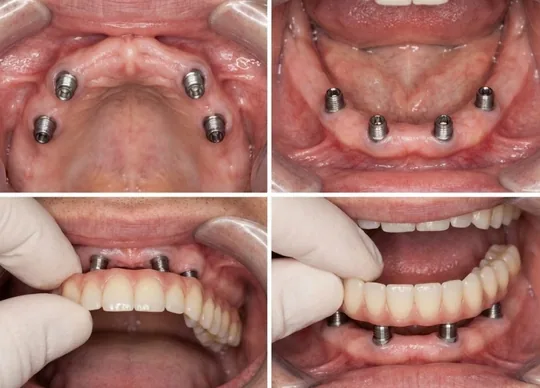
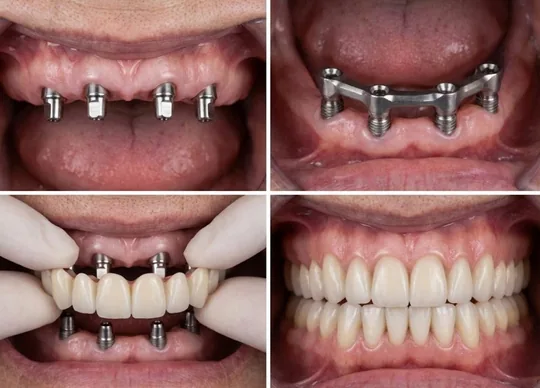
The All-on-4 Implant system is based on the principle of placing two implants vertically in the front region and two implants at an angle in the back region. Thanks to this biomechanical planning, the need for bone augmentation in the back region is often reduced. It is currently one of the most researched full-arch fixed dental treatments, with a high clinical success rate.
What Is the All-on-4 Implant?
As the name suggests, the All-on-4 Implant is a full-arch restoration system fixed onto four implants. The aim of this technique is to achieve maximum stability with the minimum number of implants. Placing the back implants at an angle allows support to be drawn from the denser regions of the jawbone. This can both reduce the need for a bone graft and increase the durability of the restoration.
Scientific publications report that, when the right cases are selected, this method has high long-term success rates. It stands out in particular as an alternative solution for patients with advanced bone loss.
Who Is All-on-4 Implant Treatment Suitable For?
The All-on-4 Implant is generally preferred in the following situations:
- Patients with complete tooth loss.
- Individuals who have lost most of their teeth.
- Those who do not wish to use a removable restoration.
- Patients with limited bone volume.
This technique can offer an advantage particularly for individuals with bone resorption in the back region. Thanks to the angled placement of the implants, anatomical structures can be avoided. However, it may not be suitable for every patient. General health status, bone density and oral hygiene habits must be assessed. The treatment plan is prepared individually for each patient.
How Is the All-on-4 Implant Performed?
All-on-4 Implant treatment begins with detailed clinical and radiological planning. Using digital tomography images, the bone structure is analysed in three dimensions. During the surgical stage, four implants are placed into the jawbone. The front implants are usually positioned vertically, while the back implants are placed at specific angles. This angling allows the restoration to extend into the back region. In many cases, a temporary fixed restoration can be fitted on the same day. For this reason, the method is also popularly known as same-day fixed teeth. However, the healing process must be completed before the permanent restoration can be fitted.
What Are the Features of the All-on-4 Implant?
| Feature | Description |
|---|---|
| Four implants | Four support points for a single jaw |
| Angled placement | Bone advantage in the back region |
| Fixed restoration | An alternative to removable restorations |
| Shorter treatment time | Rapid loading in most cases |
Comparative Assessment
In the conventional method, a separate implant is planned for each missing tooth, whereas in the All-on-4 technique the entire jaw is supported with just four implants.
Fewer implants and less surgical intervention can lead to differences in both treatment time and cost.
For individuals who want fixed teeth, improved chewing function and aesthetic outcomes have a positive effect on quality of life.
The literature reports high success rates over periods of 10 years or more. Success is directly related to care habits.
Dental Care After All-on-4
Oral hygiene is of great importance after the All-on-4 Implant procedure. The underside of the fixed restoration needs to be cleaned using special brushes and interdental cleaners. Regular clinical check-ups help maintain the health of the tissues around the implant.
Is All-on-4 Treatment Painful?
All-on-4 Implant surgery is generally carried out under local anaesthetic. No pain is felt during the procedure. Mild swelling and sensitivity may occur after the operation. This usually subsides within a short time.
Can I Eat Straight Away with All-on-4 Implants?
In most cases of All-on-4 Implant treatment, a temporary fixed restoration can be fitted on the same day. This offers an advantage in terms of both aesthetics and function. However, soft foods are recommended in the initial period. It is advised to avoid excessive force while the implants are fusing with the bone.
Treatment Duration and Age Limit
The surgical stage is generally completed in a single session. However, a healing period of several months may be required for the permanent restoration. The All-on-4 Implant is generally performed on adults; it is important that jaw development has been completed. Advanced age alone is not a barrier.
Does It Affect Speech or Voice?
During the period of adjusting to the new restoration, a difference may be noticed in certain sounds. The tongue and muscles usually adapt to the new tooth position within a short time. A fixed restoration is considered more advantageous in terms of speech stability.
💡 Important Information: The Osseointegration Process
Throughout the period during which the implants biologically fuse with the bone, maximum attention should be paid to oral hygiene, and factors that slow healing, such as smoking, should be avoided.
Scientific Approach and Long-Term Success
With the right case selection, detailed planning and regular care, successful long-term results can be achieved. This method is one of the most strategic solutions offered by modern implantology.
Frequently Asked Questions
The All-on-4 implant is a method of fitting a fixed dental restoration onto four implants placed in the jawbone. It offers a fast, aesthetic solution for cases of complete tooth loss, with a shorter and more comfortable surgical process compared with conventional implants.
It is suitable for adults who are completely edentulous or at high risk of losing their teeth. In patients with adequate jawbone, a bone graft is usually not required, which makes the treatment easier.
The procedure is carried out under local anaesthetic and, if necessary, sedation, so no pain is felt during treatment. Mild swelling or sensitivity may occur afterwards, usually resolving within a few days.
With proper oral hygiene and regular dental check-ups, All-on-4 implants are long-lasting. As long as the implants remain integrated with the bone, the restoration functions without problems and can be used for many years.
Soft foods should be eaten in the first few days after the procedure, and hard foods should be avoided. Care should include regular brushing, flossing or special cleaning tools, and six-monthly check-ups should not be missed.