

Developed for patients with severe bone loss in the upper jaw, zygomatic implant treatment is an innovative solution that goes beyond conventional implant approaches. Applied particularly when bone volume is insufficient in the posterior region, a zygomatic implant draws support from the cheekbone to make a fixed prosthesis possible. This method has attracted attention in recent years because it can reduce the need for bone grafting and deliver functional results in a shorter time.
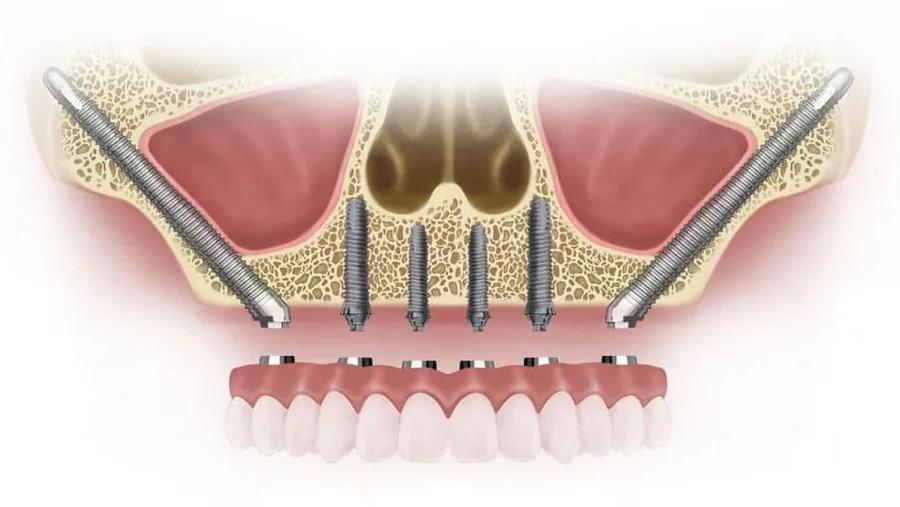
What Is a Zygomatic Implant?
The zygomatic implant takes its name from the anatomical region in which it is placed. While conventional implants are positioned in the jawbone, the zygomatic implant, thanks to its longer structure, is anchored in the zygomatic bone, commonly known as the cheekbone. With its dense, strong structure, this bone provides a solid foundation for implant stability.
Zygomatic implant systems generally range in length from 30 to 55 mm. This feature offers an alternative treatment route for individuals with advanced bone resorption in the upper jaw. In the literature, this method is considered an alternative to bone augmentation surgery in cases of severe atrophy.
While conventional implant treatments may require additional procedures such as sinus lifting or bone grafting, zygomatic implants can reduce the need for these stages in most cases. This means that both the surgical process and the recovery period can proceed with a different dynamic.
When Is a Zygomatic Implant Recommended?
Patients with severe bone loss in the upper jaw generally do not have sufficient bone volume for a standard implant. In such cases, the zygomatic implant emerges as an alternative solution. Bone resorption can be particularly pronounced in individuals who have been without teeth for a long period.
A zygomatic implant can also be planned for individuals who have previously had unsuccessful implant experiences or who are not suitable candidates for bone grafting. This technique is also considered for bone loss following tumour surgery or in cases of advanced periodontal disease.
What matters here is that every patient's anatomy is different. The density of the zygomatic bone, sinus anatomy and general health status are all factors that influence the treatment plan. For this reason, a detailed clinical and radiological analysis is of great importance.
How Is a Zygomatic Implant Placed?
Placing a zygomatic implant requires a detailed planning process. Bone structure is generally analysed using three-dimensional imaging techniques. These analyses play a critical role in determining the angle and length of the implant.
During surgery, the implant is inserted through the posterior region of the upper jaw and anchored into the zygomatic bone. This process requires a more technical approach compared with conventional implant procedures, which is why it is recommended that it be carried out by experienced surgeons.
In some cases, temporary fixed prostheses can be fitted on the same day. This is referred to in the literature as an immediate loading protocol. However, it should be emphasised that the same procedure does not apply to every patient. Clinical assessment is the decisive factor.
What Are the Advantages of Zygomatic Implants?
The most notable advantage of zygomatic implant treatment is that it can reduce the need for bone grafting in patients with severe bone loss. This can help shorten the overall treatment time.
Another advantage is that high primary stability can be achieved thanks to the strong bone support. Because the zygomatic bone is dense, the implant's potential for osseointegration can be increased. This feature can make the use of a fixed prosthesis possible.
The table below summarises the main differences between the conventional implant approach and the zygomatic implant approach:
|
Feature |
Conventional Implant |
Zygomatic Implant |
|
Placement Site |
Upper jawbone |
Cheekbone |
|
Bone Graft |
Often required |
Not required in most cases |
|
Length |
8-15 mm |
30-55 mm |
|
Advanced Atrophy Cases |
Limited |
Suitable alternative |
This table offers a general comparison. The final decision is made following an individual assessment.
Risks and Limitations of Zygomatic Implants
As with any surgical procedure, zygomatic implant placement can carry certain risks. Because the surgical field is close to the sinus cavity, detailed planning is required. Anatomical variations can affect the treatment plan.
The procedure time and level of technical difficulty can also differ from conventional implants, which is why surgeon experience matters. Although studies on long-term success rates show promising results, it should be remembered that the same outcome cannot be guaranteed for every patient.
Zygomatic implant treatment may require a multidisciplinary approach. Surgical planning, prosthetic design and follow-up care are all assessed as a whole.
The Process After a Zygomatic Implant
The recovery process after zygomatic implant surgery can vary from person to person. Mild swelling and tenderness may be seen in the first few days. This is regarded as a natural response observed in most surgical procedures.
Follow-up appointments are important for assessing implant stability and soft tissue health. Regular check-ups and good oral hygiene play a major role in long-term success.
Prosthetic planning is also an important part of the process in zygomatic implant treatment. Individually tailored solutions can be developed in line with aesthetic and functional expectations.
Aesthetic and Functional Benefits of Zygomatic Implants
Zygomatic implants not only support chewing function but can also have an indirect effect on facial aesthetics. Facial sagging caused by missing teeth can be balanced out through fixed prosthetic treatment.
From a functional perspective, using a fixed prosthesis can improve comfort in speech and eating. This can also be reflected in quality of social life. Of course, every individual's expectations and experience differ.
As a product of advanced surgical techniques, zygomatic implant systems have secured an important place in modern implantology. Developments in this field, combined with digital planning technologies, aim to deliver more predictable outcomes.
The zygomatic implant is an innovative treatment option considered for upper jaw cases with severe bone loss. This long implant system, supported by the cheekbone, can offer an alternative to bone augmentation procedures. However, suitability for each patient requires detailed analysis.
At Doctor Afra, our aim is to answer all the questions people have about zygomatic implants within a scientific and accessible framework. Individual assessment is essential in treatment planning, and a personalised approach always comes first.
Book an appointment for your smile
Get in touch with us for your questions and treatment options.