

Tooth loss is not simply an aesthetic problem; it affects everything from chewing function and speech to facial profile and self-confidence. This is where the All-on-4 Implant technique stands out as one of the modern approaches offering a fixed prosthesis alternative for fully edentulous patients. Also known as "full jaw restoration with four implants", this system is based on the principle of placing a fixed prosthesis on four implants in a single jaw, following careful planning.
What Is All-on-4 Implant Treatment and How Does It Work?
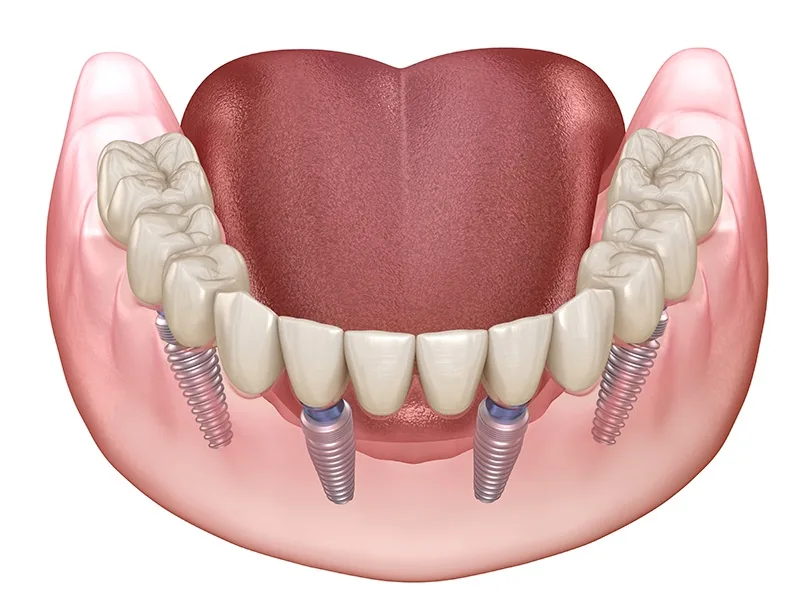
All-on-4 Implant treatment is a concept aimed at fixing a full-arch prosthesis onto four dental implants strategically placed in the lower or upper jaw. In this system, two implants are placed vertically at the front, while two implants are placed at a specific angle towards the back. This angled placement is intended to reduce the need for bone grafting in cases where bone volume at the back of the jaw is limited.
Compared with traditional multiple-implant treatments, this technique aims to achieve a fully fixed prosthesis using fewer implants. From a biomechanical perspective, angling the implants helps distribute chewing forces over a wider area, which can reduce the load on each individual implant.
Panoramic X-rays, three-dimensional tomography and digital scanning systems are used during the clinical planning process. Based on this data, All-on-4 Implant treatment is planned individually for each patient.
When Is All-on-4 Implant Treatment Preferred?
All-on-4 Implant treatment is generally considered for individuals who are fully edentulous or whose remaining teeth have a poor prognosis. Bone resorption can occur in people who have experienced long-term tooth loss. In such cases, if bone volume is sufficient, planning a fixed prosthesis on four implants may be possible.
The system may be considered in the following situations:
- Complete edentulism
- Advanced periodontal disease
- Dissatisfaction with removable denture use
- Patients who wish to avoid bone grafting
However, suitability is not the same for every patient. Bone density, systemic health status and jaw anatomy are all assessed in detail. The All-on-4 Implant concept requires planning that is shaped according to individual needs.
How Does the All-on-4 Implant Treatment Process Proceed?
The All-on-4 Implant treatment process generally consists of several stages. The first step is a detailed examination and radiological analysis. Thanks to digital planning, the position of the implants is determined in advance. This stage is considered critical for long-term success.
During the surgical stage, four implants are placed. In some cases, a temporary fixed prosthesis can be fitted on the same day. This approach is also known as the "teeth in a day" concept. However, this may not be suitable for every patient.
The healing process can take several months. During this period, a biological bond forms between the implant and the bone. This process is called osseointegration. In the final stage, the permanent prosthesis is prepared and fixed onto the implants.
Advantages and Limitations of All-on-4 Implants
As with any treatment approach, the All-on-4 Implant system has its own advantages and limitations. Advantages include the use of fewer implants, a reduced need for bone grafting, and the comfort of a fixed prosthesis.
The table below presents a general comparison:
|
Criterion |
All-on-4 Implant |
Traditional Multiple Implants |
|
Number of Implants |
4 |
6-8 |
|
Need for Bone Grafting |
May be lower |
May be higher |
|
Surgical Duration |
Shorter |
Longer |
|
Cost |
Relatively more economical |
May be higher |
The limitations, on the other hand, depend on bone quality. Correct positioning of the implants is of great importance. In addition, the fact that the entire load is concentrated on four implants makes biomechanical planning critical.
The Relationship Between All-on-4 Implants and Bone Structure
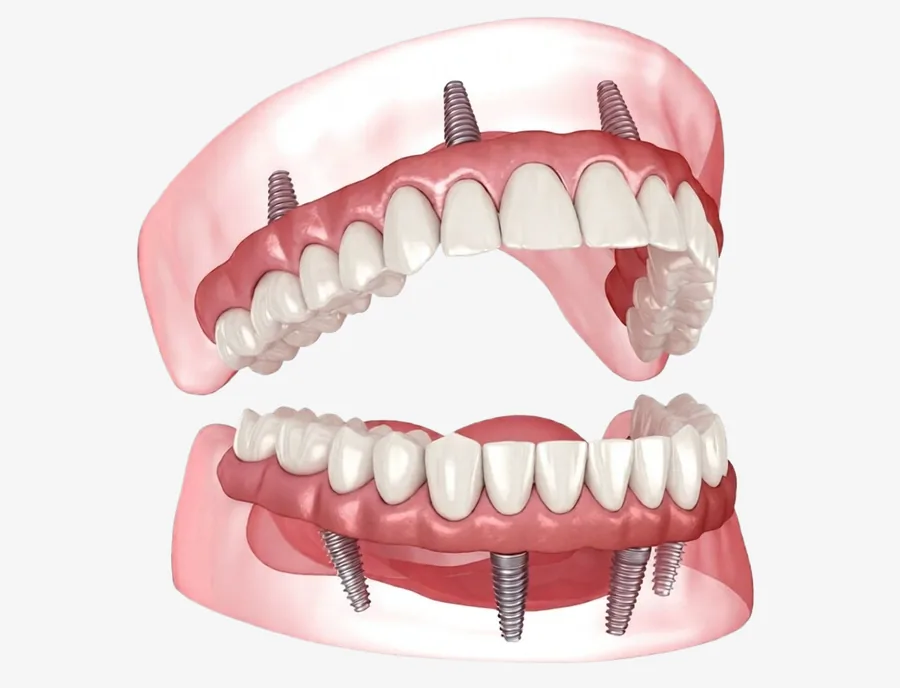
Bone volume and density are decisive factors in All-on-4 Implant planning. Resorption of the alveolar bone can occur in individuals who have experienced long-term tooth loss. Anatomical structures such as the sinus cavity or nerve canal, particularly at the back of the jaw, can be limiting factors.
Angled implant placement aims to overcome these anatomical obstacles. This means a fixed prosthesis can be planned without the need for advanced surgical procedures. However, if bone quality is poor, additional procedures may become necessary.
The scientific literature reports high long-term success rates for All-on-4 Implant treatment. That said, success depends on patient hygiene, regular check-ups and correct planning.
Life and Adaptation After All-on-4 Implants
The adaptation process after treatment can vary from person to person. Following All-on-4 Implant treatment, using a fixed prosthesis can feel more natural compared with removable dentures. A noticeable improvement in chewing function can be observed.
Mild sensitivity or a period of speech adaptation may be experienced in the first few weeks. This is usually temporary. Oral hygiene is important for the health of the tissues around the implants. Special brushes and interdental cleaners may be recommended.
In the long term, the preservation of the All-on-4 Implant system is supported by regular dental check-ups. Cleaning beneath the prosthesis and professional maintenance should not be neglected.
Factors Affecting the Cost of All-on-4 Implants
The cost of All-on-4 Implant treatment depends on many variables. The implant brand used, the prosthesis material, digital planning technologies and clinical experience can all be determining factors in the price.
The factors that generally affect price are as follows:
- Clinic infrastructure and technology
- Clinician experience
- Additional surgical procedures
- Temporary and permanent prosthesis materials
Because personalised planning is carried out for each patient, an exact price is determined following examination. For this reason, the most accurate information about All-on-4 Implant treatment is obtained through an individual assessment.
All-on-4 Implants: A Scientific Approach to Restoration
The All-on-4 Implant technique is an innovative concept aimed at achieving a fixed prosthesis in fully edentulous patients. A functional and aesthetic outcome is targeted using fewer implants. However, suitability is not the same for every patient and requires detailed analysis.
Treatments carried out at Doctor Afra are shaped on an individual basis in line with digital planning and scientific data. With the right patient selection and regular maintenance, the All-on-4 Implant approach can offer a long-term solution.
Dental health is not just an aesthetic matter; it is a factor that directly affects quality of life. For this reason, it is always important to gather comprehensive information when considering treatment options.
Book an appointment for your smile
Get in touch with us for your questions and treatment options.