
What Is an Implant-Supported Removable Denture (Overdenture)?
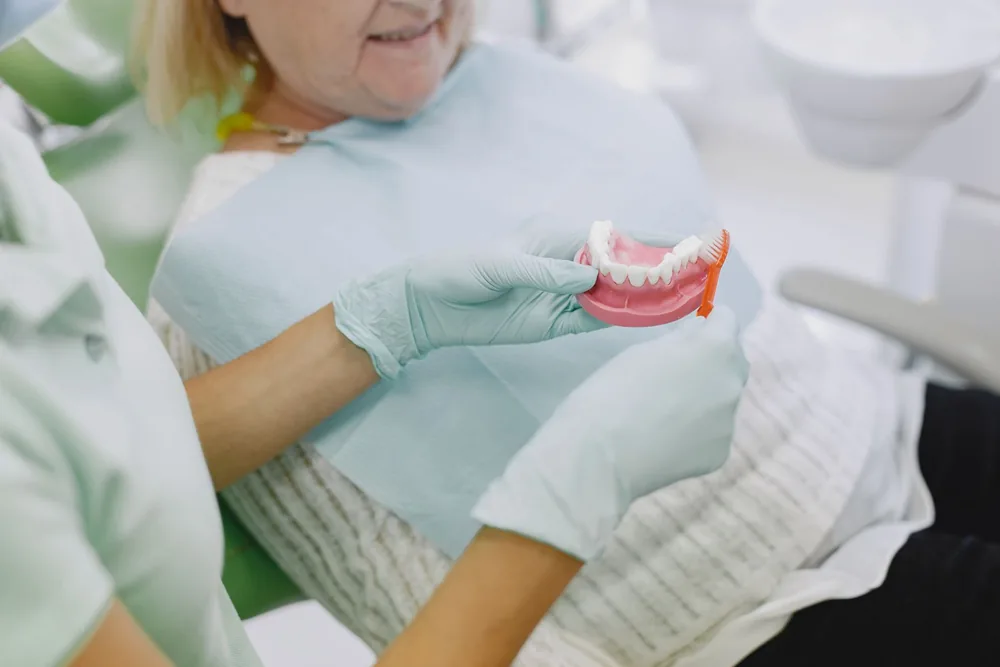
Treatment options for complete tooth loss aren't limited to a conventional denture on one end and a fixed implant prosthesis on the other. There is another option in between: the implant-supported removable denture, commonly known as an overdenture. In this approach, the denture is supported by a small number of implants but can still be removed by the patient. In this article we look at how an overdenture works, when it comes into consideration, and how it is cared for.
What Is an Overdenture?
An overdenture is a denture that connects to implants placed in the jaw via special attachments and can be removed when needed. What separates it from a conventional full denture is that it doesn't rely solely on gum and bone support; the implants keep it in place during chewing. What separates it from a fixed prosthesis is that the patient can take it out and put it back in themselves.
Attachment Types
Locator (Individual Attachment) Systems
A separate attachment cap is placed on each implant, and the corresponding parts on the inner surface of the denture seat onto these caps. Cleaning is relatively easy, and the retention parts can be replaced when they wear.
Bar-Retained Systems
The implants are connected to each other with a metal bar, and the denture seats onto this bar. This allows the load to be distributed more evenly between implants, but cleaning beneath the bar requires more care.
When Does It Come into Consideration?
- In patients who struggle with a conventional lower denture moving around
- In cases without enough bone support for the number of implants a fixed prosthesis requires
- In patients who prefer being able to clean the denture themselves
- Where the aim is to keep the surgical scope and cost more limited
Where bone volume is insufficient, options can be assessed together with sinus lifting and bone grafting.
Compared with a Fixed Prosthesis
Fixed prostheses are structures screwed or cemented to implants that the patient cannot remove; All-on-4 and All-on-6 are the well-known examples of this group. Compared with these options, an overdenture can generally be done with fewer implants, and cleaning underneath is easier because the denture comes out. On the other hand, it may not fully replicate the "like your own teeth" feel that fixed prostheses provide, and the retention parts need replacing at intervals. For a general comparison between the two groups, see our article on implant treatment for an edentulous jaw. For information about full-arch options, see our All-on-6 implant page.
How Is It Cared For?
- The denture should be removed and cleaned with a denture brush at least once a day.
- The implant attachment caps in the mouth are cleaned with a soft brush, including around them.
- Whether the denture should be removed at night is decided by the dentist; taking it out is usually recommended so the tissues can rest.
- Retention parts wear over time; when retention decreases, these parts are renewed.
- Regular check-ups shouldn't be missed so the tissues around the implants can be monitored.
For the inflammatory process that can develop in tissues around implants, we recommend reading our article on peri-implantitis.
Two Common Questions
How many implants are needed? The number varies by jaw and clinical situation; some cases in the lower jaw can be treated with fewer implants, while the upper jaw generally needs more support. The decision is made after three-dimensional imaging.
Can the denture come out on its own? While the attachments are in good condition, the denture stays in place during chewing. If retention decreases over time, that's a sign the parts need renewing.
Summary
An overdenture is a denture option supported by implants but removable by the patient. It provides noticeably better retention than a conventional denture, while generally requiring fewer implants than a fixed prosthesis and being easier to clean. Determining the right option means assessing bone condition and the patient's expectations together.
This article is intended for general information purposes. A clinical examination and imaging are required to determine the right prosthesis option for you.