

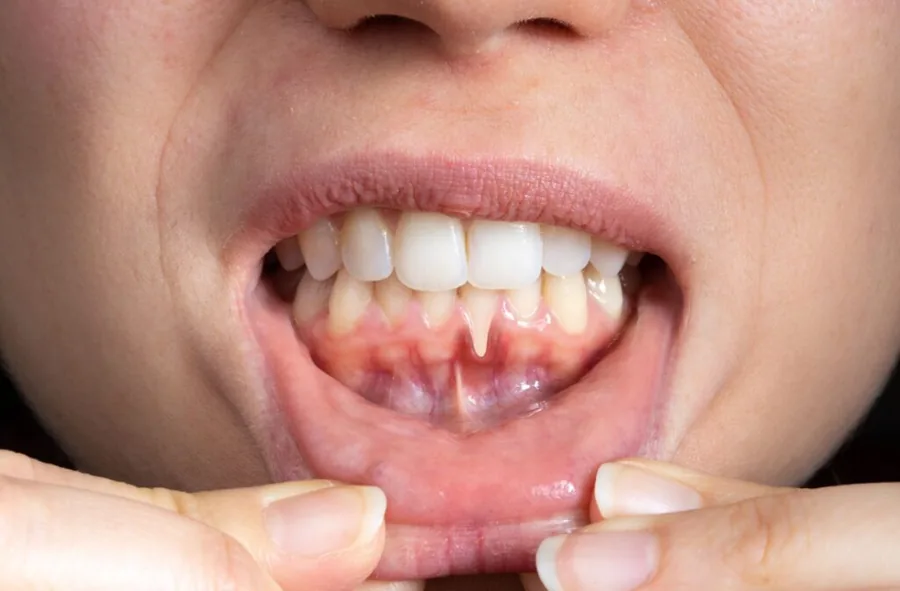
Gum recession occurs when the soft tissue surrounding the teeth gradually pulls back, exposing the tooth roots. Many people today notice, when looking in the mirror, that their teeth appear longer than they used to, and wonder what's causing the change. Although gum recession may seem like a purely cosmetic issue, it's actually closely linked to oral health and can arise from a range of different causes.
What Is Gum Recession and How Is It Defined?
Gum recession is defined as the gum pulling away from the tooth surface, exposing the root beneath. Normally, the gum wraps around the tooth like a cuff, acting as a protective barrier against external factors. When this balance is disrupted, the tooth root can become exposed.
Gum recession can affect a single tooth or several teeth at once. In some people it progresses slowly, while in others it becomes noticeable in a shorter space of time. How it is perceived varies from person to person, and it's often picked up incidentally during routine check-ups.
In scientific studies, gum recession is treated as either an adaptive or a pathological change in the periodontal tissues. In other words, not every case of recession develops for the same reason or at the same rate — which makes the subject more complex, but equally fascinating.
What Causes Gum Recession?
Gum recession is difficult to attribute to a single cause. It usually develops from a combination of several factors, which can be biological, mechanical or environmental in nature.
Some of the common factors associated with gum recession include:
- Brushing too hard or with poor technique
- A genetically thin gum structure
- A tendency to clench or grind the teeth
- Plaque and tartar build-up
- The long-term effect of orthodontic forces
Each of these factors can affect the gum recession process in a different way. For example, in some individuals genetic predisposition plays the leading role, while in others daily habits can be the deciding factor.
Research shows that the biotype of the gum tissue — whether it's thick or thin — influences the risk of recession. In individuals with a thin biotype, gum recession may become noticeable earlier.
Does Gum Recession Progress?
One of the most common questions people ask about gum recession is whether it keeps progressing. There's no fixed answer, because the rate of progression depends on individual factors.
Gum recession can remain stable for many years in some people, while in others it increases periodically. Whether it progresses is linked to oral hygiene habits, the resilience of the gum tissue, and environmental factors.
Scientific observation shows that gum recession does not reverse on its own, although it can become stable under certain conditions. This is why it's important to carefully assess the process as soon as recession is noticed.
It's also worth noting that gum recession doesn't always lead to dramatic consequences. In some cases it produces only a cosmetic difference, while in others secondary effects such as sensitivity may appear.
What Are the Symptoms of Gum Recession?
Gum recession doesn't always start with obvious complaints, which can make it harder to spot in its early stages. Over time, however, certain telltale signs may appear.
Common symptoms associated with gum recession include:
|
Observed Change |
Description |
|
Teeth appearing longer |
Occurs when the gum line recedes |
|
Visible tooth root |
The root surface, normally hidden, becomes noticeable |
|
Sensitivity to hot and cold |
Linked to the exposure of the root surface |
|
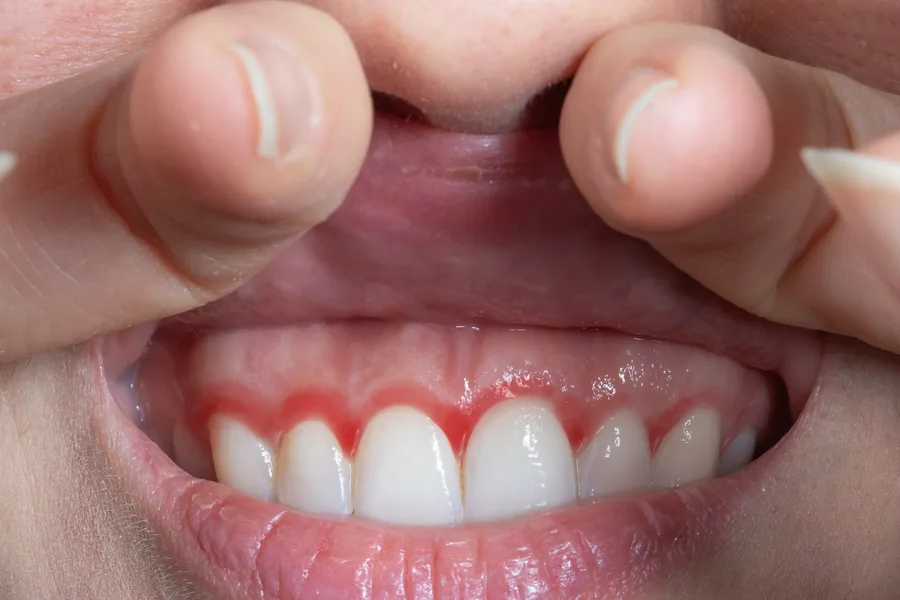
Uneven gum line |
A difference in gum level can develop between teeth |
These symptoms offer important clues about the course of gum recession. However, not every sign appears in every individual — some people notice only a visual change, while others experience different sensory effects.
How Is Gum Recession Assessed?
When assessing gum recession, it's not just the visible part that matters — the underlying tissue structure is taken into account too. Gum level, root length and the surrounding tissues are examined as a whole.
In modern dentistry, gum recession is analysed using millimetre-level measurements, which help track how it changes over time. Gum thickness and tooth position are also part of the assessment process.
Research shows that gum recession tends to progress more slowly in its early stages, becoming more sensitive to environmental factors as it advances. This is why regular monitoring is important.
Photographic records and digital analysis can also be used in this process, allowing changes in gum recession over time to be tracked more clearly.
What Are the Treatment Approaches for Gum Recession?
There is no single approach when it comes to gum recession. Different methods may be considered depending on the assessment findings.
The approaches considered for gum recession generally fall under the following headings:
- Reviewing daily habits
- Measures aimed at protecting the gum tissue
- Surgical evaluation where necessary
Which of these approaches takes priority depends on the degree of recession and individual factors. In some cases monitoring alone is sufficient, while in others more extensive methods may be considered.
Scientific publications show that gum recession is assessed more accurately when approached from a multidisciplinary perspective — meaning that tooth position and chewing forces are considered alongside the gum tissue itself.
What Do Current Studies Say About Gum Recession?
Studies conducted in recent years show that gum recession is not merely a localised issue, but is connected to the broader oral ecosystem. Microbial balance, saliva composition and tissue response all play a role in this process.
Analyses of gum recession have also assessed individuals' stress levels and parafunctional habits alongside their oral care routines, underlining just how multidimensional the subject is.
Digital dentistry tools also make it possible to detect gum recession at an earlier stage and analyse it in greater detail — developments that feature prominently in the scientific literature.
Taking an Informed View of Gum Recession
Gum recession is a condition many people may encounter at some point in their lives. However, not every case of recession means the same thing, and it doesn't progress the same way in every patient. This is why the subject should be approached holistically rather than from a single angle.
Book an appointment for your smile
Get in touch with us for your questions and treatment options.