
All-on-4 or All-on-6? Choosing a Full-Arch Implant Treatment
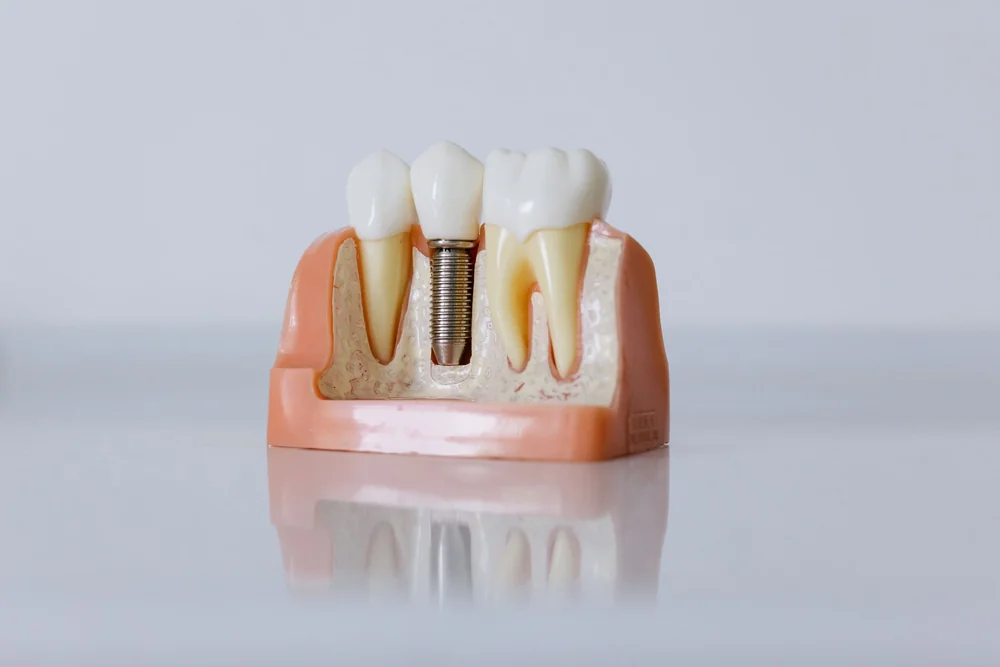
One of the questions we hear most often from patients who have lost all of their teeth — or are close to losing them — is: "Can I have fixed teeth again?" Modern implant dentistry offers full-arch treatment concepts that provide a fixed alternative to removable dentures, and the two names patients encounter most are All-on-4 and All-on-6. Although they sound almost identical, there are meaningful differences between them, from the number of implants to the amount of bone each approach requires. In this article we explain what the two concepts are, how they differ and in which situations each one may be considered.
The All-on-X Concept: A Fixed Arch on a Small Number of Implants
The core idea behind full-arch treatment is simple: instead of placing a separate implant for every missing tooth, an entire arch of teeth is secured on a limited number of strategically positioned implants. "All-on-4" means the bridge rests on four implants; "All-on-6" means it rests on six. Both belong to the same family of treatments and share the same aims:
- Providing a prosthesis that stays fixed in the mouth and does not cover the palate
- Improving chewing power and speech comfort compared with removable dentures
- Completing treatment within a relatively short timeframe in suitable cases
- Helping to slow bone loss through the stimulation implants transmit to the jaw
For patients, the greatest appeal of these approaches is that they aim to eliminate the familiar complaints of removable dentures — the gagging sensation caused by a plate covering the palate, reduced sense of taste, and the prosthesis shifting during the day.
What Is All-on-4?
In the All-on-4 approach, four implants are placed in a fully edentulous jaw. The two front implants are positioned vertically, while the two posterior implants are tilted at roughly 30–45 degrees. This angled placement is designed to make efficient use of the available bone in patients with resorption at the back of the jaw, keeping a safe distance from anatomical structures such as the sinus cavity and nerves. When conditions allow, a fixed provisional bridge can be attached on the same day or within 24–72 hours, which is why the method is sometimes described as "same-day teeth". We cover the technique in detail in our article what is the All-on-4 implant technique.
What Is All-on-6?
With All-on-6, the same type of fixed bridge is supported by six implants, with the two additional fixtures usually placed towards the middle and back of the arch. Chewing forces are therefore distributed across more points, reducing the load carried by each individual implant. Placing six implants does, however, require sufficient bone volume in the posterior regions as well, so All-on-6 tends to be considered for patients whose bone is relatively well preserved. You can read more about how the process works on our All-on-6 implant page.
The Key Differences Between the Two Methods
Number of implants and load distribution
The most obvious difference is the number of implants: four versus six. With six implants, chewing forces are spread over a wider area, which can be a biomechanical advantage in patients with strong bite forces or longer bridge spans. That said, the four-implant design was developed precisely to balance loads through its tilted implants — fewer implants does not automatically mean a weaker treatment.
Bone volume requirements
All-on-4 was designed to reduce the need for bone grafting in patients with posterior bone resorption. All-on-6 requires more bone volume because implants are also placed further back; where bone is insufficient, grafting or sinus lift procedures may be added to the plan.
Duration, cost and maintenance
As the number of implants increases, the surgical scope and cost generally rise — but so does the number of points supporting the bridge. With either method, the longevity of the prosthesis is closely linked to regular check-ups and good oral hygiene.
When Bone Is Severely Reduced: Zygomatic Alternatives
Some patients with advanced bone loss in the upper jaw do not have enough bone for either four or six standard implants. In these cases, zygomatic implants, which anchor in the cheekbone rather than the jawbone, may come into consideration. We explore this option in our article on zygomatic implants. Which advanced technique is appropriate is, again, planned according to the imaging findings.
Which Approach Is Considered in Which Situation?
There is no single answer that applies to everyone; the choice is made afresh for each patient. As a general framework:
- All-on-4 may be considered for patients with posterior bone resorption, those who prefer to avoid grafting or are not suitable for it, and those who wish to receive fixed teeth within a short timeframe.
- All-on-6 may be considered where bone volume is adequate, bite forces are strong, or the aim is to distribute the load across more implants.
- Zygomatic or other advanced techniques may be planned for upper-jaw cases where standard implants cannot be supported by the remaining bone.
General health, medication, smoking, tooth grinding (bruxism) and the condition of the opposing teeth also influence the decision. If you still have some natural teeth and are weighing up your options, our comparison implant or bridge may be helpful.
How Does the Treatment Process Work?
With both methods, treatment follows similar steps:
- Examination and CT imaging: Three-dimensional imaging is used to assess bone volume and the position of the sinuses and nerves.
- Planning: The number and position of the implants and the bridge design are determined digitally.
- Surgery: The implants are placed under local anaesthesia, with sedation available if preferred.
- Provisional bridge: In suitable cases, a fixed provisional bridge is fitted within a short time.
- Final prosthesis: Once the implants have integrated with the bone (usually 2–4 months), the final bridge is made from precise impressions.
We describe what to expect during recovery, step by step, in our article on aftercare and healing following implant treatment.
The Decision Is Made at Your Examination
Neither All-on-4 nor All-on-6 is superior for every patient; both can deliver successful outcomes in the right candidate with the right planning. Which one suits you is determined by your dentist, based on a clinical examination combined with three-dimensional CT findings. The information in this article is intended for general guidance only; a clinical examination is required for an individual diagnosis and treatment plan.
Frequently Asked Questions
Is All-on-6 always superior to All-on-4?
No. Six implants distribute the load across more points but require more bone volume. In patients with bone resorption, four tilted implants may be the more suitable plan. The right option is decided on the basis of examination and CT findings.
Can fixed teeth be fitted on the same day?
If the implants achieve sufficient stability at placement and overall conditions are favourable, a fixed provisional bridge can be attached on the same day or within a few days. The final bridge is made once integration with the bone is complete.
Is the treatment painful?
The procedure is carried out under local anaesthesia, and sedation can be planned if you prefer. Any tenderness and swelling afterwards usually subside within a few days and can be managed with the medication your dentist recommends.